How to Choose a Board Game for Your Group
Most disappointing board games are not bad games; they are games bought for the wrong group. A heavy strategy game is wonderful at a table of committed players and miserable at a relaxed dinner party, and a light party game has the opposite problem. Choosing well is therefore less about finding the perfect game and more about answering four simple questions honestly. This article walks through those questions and shows how they narrow even a very large shelf down to a short list.
How to Choose a Game for Your Group
Choosing a game is really a matter of matching four numbers: how many people will play, how long they will sit, how complicated the rules can be and how much they enjoy luck. Write those four down honestly and most of the shelf narrows itself. A game that ignores any one of them will sit unplayed.
The most common mistake is buying for an ideal group rather than the real one. Thinking about the people who actually turn up, with their actual attention span and their actual tolerance for rules, leads to far better purchases. Buying slightly lighter than you think you need is almost always the safer choice.
Games for a Mixed Table of Adults
The best group games share a rare quality: everyone can join in without waiting for someone to catch up. They keep turns short, rules simple and the gap between a newcomer and an experienced player narrow. That balance is worth more than any clever mechanic, because a game nobody wants to play is not really a game at all.
It also helps to look at how a game handles defeat. Games that keep the trailing player close until the final turn tend to work far better with a mixed group than games that punish early mistakes. A narrow finish keeps everyone interested and gives the whole table a reason to come back next week.
Building a Small, Well-Chosen Collection
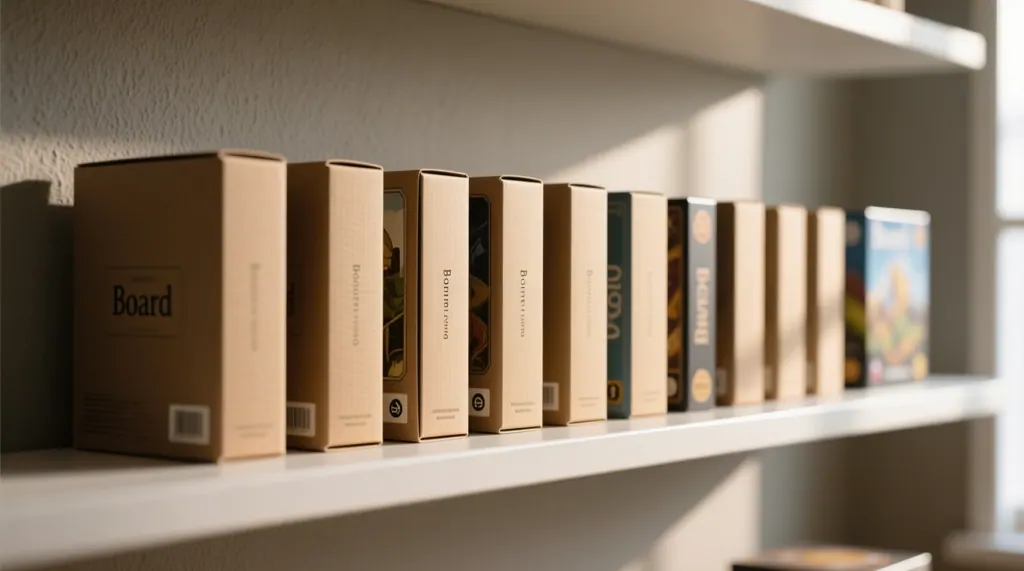
A collection of ten well-chosen games will be played far more than a collection of fifty. The useful way to think about a shelf is coverage: one short filler, one party game, one lighter group game, one two-player game and one longer strategy game will handle almost every occasion a grown-up table meets.
Adding to that shelf is best done slowly. Play what you have until you can describe exactly what is missing, and buy for that gap rather than for whatever looks exciting in a shop. A collection built this way stays in use for years instead of turning into a stack of unopened boxes.
Setting Up a Game Night
A successful game night is decided mostly before anyone arrives. A cleared table, the right number of chairs, decent light overhead and a drink within reach remove almost every small obstacle that stops a game getting started. Twenty minutes of preparation buys three hours of play.
It also helps to decide the first game in advance, or at most to offer two options. A table that spends forty minutes choosing often plays nothing at all, and the momentum of a group is fragile. Start with something short and let the evening build from there.
Strategy Board Games for Beginners
Strategy games have a reputation for being difficult, and the reputation is partly deserved and partly misleading. What beginners actually need is not a simple game but a clear one, where the goal makes sense and the choices are visible. Many games with plenty of depth are easy to start if the rules are explained in the right order.
A good first strategy game keeps the number of options small and the feedback fast. If a decision takes a long time to show its consequences, a new player cannot learn from it, and the game becomes frustrating rather than interesting. Fast feedback turns a complicated game into a teachable one.
Party Games and Large Groups
Party games are built for noise, laughter and quick rounds rather than deep strategy. Their rules can usually be explained in a minute, and their length suits a group that is still arriving, still eating or still deciding what to do next. Keeping a couple of these nearby makes any gathering easier to start.
The challenge with party games is keeping everyone involved when the group is large. Games that split the table into teams, or that give every player something to do on every turn, work much better than games where people wait their turn in a long queue. Turn length matters more than total length in a crowded room.
Reading the Table and Playing Well
Winning a board game is usually less about a single clever move than about noticing what the other players are doing. Which resources are running out, who is close to finishing and what everyone else seems to be planning all matter more than the strength of your own position. Attention beats cleverness in most group games.
It also pays to think in terms of the next two turns rather than the whole game. A plan that stretches too far ahead collapses as soon as someone does something unexpected, while a short horizon can be adjusted without losing much. Strong players are usually the ones who revise their plan quickly rather than the ones who see furthest.
Losing Well and Keeping Games Friendly
How a group handles losing decides whether it keeps playing together. A game that ends with a sulk, an argument or a long explanation of what someone should have done is a game that will not be suggested again. The point of a session is the evening, not the result.
The simplest habit is to keep the finish light. Congratulate the winner, clear the table, and let whoever lost change the subject without being quizzed. A group that behaves this way keeps its table pleasant far more reliably than one that re-litigates every defeat on the way home.
- Count how many people will realistically be at the table.
- Decide the maximum time anyone will happily sit still.
- Be honest about how much rule explanation your group tolerates.
- Consider whether your group enjoys luck or prefers pure skill.
- Buy slightly lighter than you think you need.
- Check the player count printed on the box carefully.
| Question | Answer to look for | What it rules out |
|---|---|---|
| Player count | Matches your usual group | Games for other sizes |
| Play time | Fits your evening | Anything much longer |
| Complexity | Explainable in ten minutes | Very heavy rulebooks |
| Luck level | Fits your group's mood | Games that clash with taste |
| Repeatability | Different every time | One-trick designs |
The best game for your group is the one that actually gets played. Be honest about the people who turn up rather than the people you wish turned up, and you will rarely be disappointed.