Choosing Quality Playing Cards

A deck of cards is the least expensive thing on a table and the thing handled most. Its stock weight, its finish and the crispness of its cut decide how it shuffles, how it fans and how it feels in the hand after three hours, and those small qualities shape whether an evening flows or snags. This guide looks at what separates a well-made deck from a cheap one, how to judge cards by touch before you commit, and how a little care keeps a good deck good for years of regular play.
What Makes a Good Deck of Playing Cards
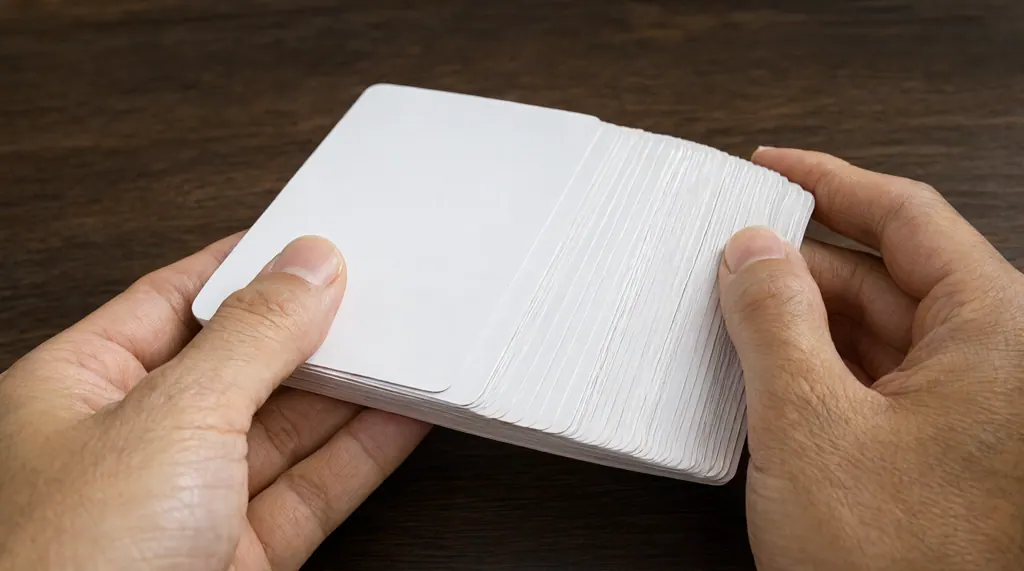
A deck is the cheapest piece of equipment on the table and the one players handle most, so its finish decides how an evening feels. Stock weight, a low-friction coating and cleanly cut edges separate a deck that shuffles smoothly for hours from one that clumps, bends and betrays the card at the back of the hand.
It is worth learning to read a deck by touch rather than by price alone. A firm snap when the cards are riffled and a crisp, even border on every face are reliable signs of good manufacture. Decks that fan without sticking and spring back flat will still be pleasant in a year of regular play.
Judging Build Quality Before You Buy
Quality at the table is not the same as expense. Thick card stock, boards that lie flat, pieces that stack without toppling and a box with a real insert all signal a game built to be played rather than displayed, and none of them are guaranteed by a high price alone.
The useful test is to handle the components before committing. Open the box if you can, feel the cards, set the board down and see whether it rocks. A game whose pieces feel solid in the hand tends to survive the years of shuffling and sorting that a favourite game receives.
Caring for Cards, Boards and Pieces
Cards and boards age in predictable ways, and most of the damage is avoidable. Greasy fingers, sunlight and heat bend and stain cards, while a board left in a warm room warps along its fold. Clean hands, a shaded shelf and a habit of closing the box properly prevent nearly all of it.
When something does wear, a small repair kit is more use than a replacement. A little archival tape, a spare set of sleeves, a cloth bag for loose counters and a note of which piece goes where will carry a well-used game through many more sessions without spoiling its feel.
Table Etiquette for Serious Play
Gear and manners are closer than they look. Handling cards gently, not bending them while thinking and keeping drinks away from the felt are all acts of respect for the equipment and for the people sharing it, and a table where these habits hold is simply more enjoyable to play at.
The same goes for the quieter courtesies: announcing a roll clearly, keeping a tidy stack of chips and putting pieces back where they belong at the end. None of it is fussy, and all of it tells the other players that their evening and their equipment are being looked after.
Storage, Inserts and Keeping Components Safe
Most damage to a game happens between sessions rather than during them. Boards stored flat rather than upright, cards kept in a firm box and small pieces bagged by type all prevent the slow warping, scuffing and scattering that ages a collection faster than play ever could.
A box that is pleasant to open gets opened more often. A simple insert, a few cloth bags and a labelled compartment turn a jumble of loose pieces into something that can be set out in a minute. The habit of packing away completely after each session is worth more than any clever storage gadget.
Building a Shelf You Will Actually Use
A shelf of gear, like a shelf of games, works best when every item earns its place. One dependable deck, one set of dice that rolls straight, a tidy set of chips and a couple of storage solutions handle almost every evening a grown-up table meets, without turning the room into a stockroom.
The discipline is to add slowly. Use what you have until you can say exactly what is missing, then buy for that gap rather than for the newest thing on a shelf. Equipment chosen this way stays in use for years, and the space it takes up stays manageable.
Collecting Out-of-Print and Vintage Games
Collecting older games is really a study in editions. The same title changes between printings in its components, its artwork and sometimes its rules, and a serious collector learns to identify which printing is on the table before deciding whether it is worth having.
The reward is often in what a long out-of-print edition reveals about play. Older rulebooks show how a hobby thought about balance and luck before modern designs standardised it, and a well-kept vintage set plays just as well today if its pieces are complete. Condition matters, but completeness matters more.
Clubs, Tournaments and Organised Play
Stepping from a kitchen table to organised play changes what equipment means. A club night asks for gear that travels well and stands up to a room full of strangers, and it rewards players who keep their set clean, complete and ready to be used by anyone at the table.
Tournaments also bring a useful discipline to how a player handles the pieces. Shuffling cleanly, rolling on the marked surface and keeping chips stacked and counted are courtesies that keep a long event moving, and they are the same habits that make a home table pleasant to sit at.
- Riffle the deck and listen for a firm, even snap rather than a soft slap.
- Check that the borders are cut evenly on every face.
- Fan the cards; a good deck spreads without sticking or clumping.
- Prefer a linen or air cushion finish for long sessions.
- Keep a spare deck sealed so a worn one can be retired at once.
- Store cards flat, out of sunlight and away from heat.
| What to look at | Why it matters |
|---|---|
| Stock weight | Decides how the deck shuffles and springs back |
| Finish | Controls glide, fanning and how long the deck lasts |
| Cut and borders | Even edges keep handling smooth and avoid marked cards |
| Corners | Rounded corners resist fraying far better than square ones |
| Case and box | A firm box protects the deck between sessions |
A good deck does not have to be expensive, but it has to feel right in the hand. Riffle it, fan it, look along the edges, and buy the one that behaves. Looked after properly, that deck will outlast several replacements and be the quiet standard every other deck is measured against.