Card Game Etiquette and Table Manners
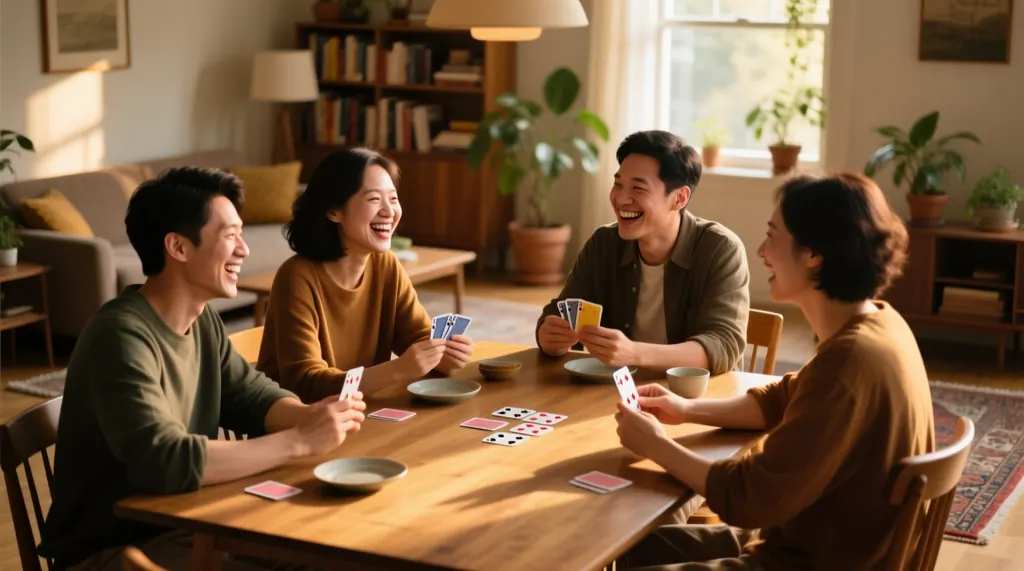
Ask a group of regular players what spoils a card evening and almost none of them will mention the rules. They will mention the person who sighs at every play, the one who deals unevenly or the one who explains, at length, what everybody else did wrong. Card games are social occasions first, and the courtesies around the table carry more weight than any strategic detail. This article sets out the habits that make a table pleasant, the behaviour that quietly ruins it and how to raise a small problem without starting an argument.
Card Table Etiquette and Good Manners
Card games are social before they are competitive, and the small courtesies matter more than the rules. Deal carefully, pass the pack in the same direction every time and keep your cards above the table so nobody has to wonder what you are holding. None of these cost anything, and all of them make the game run smoothly.
The harder courtesies are the ones about speech. Repeating a play, sighing at a partner's choice or explaining what someone should have done are all ways of spoiling a pleasant evening, even when the advice is correct. At a friendly table it is usually better to stay silent and let people find their own way.
Teaching a Card Game to Newcomers
The way you teach a game decides whether it gets played again. Starting with the goal, then the three rules needed for the first round, and leaving the rest until they come up is far kinder than reciting the whole rulebook. People remember rules they have already needed, and forget rules they were told in advance.
Play the first hand with the cards face up for a newcomer, and let them make a bad choice without interruption. One mistake experienced at the table teaches more than ten warnings, and it also removes the fear of getting something wrong. A calm first game is the best investment you can make in a regular group.
House Rules and How to Use Them
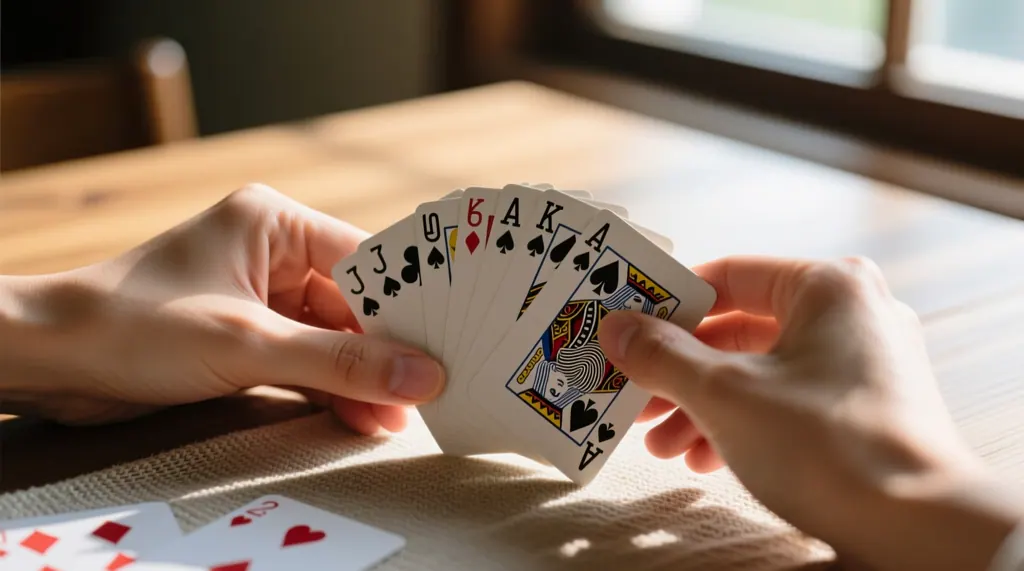
Almost every group invents a house rule sooner or later, and that is part of the fun. A local variation can smooth over a slow start, add a little excitement or simply suit the people at the table. The only real rule about house rules is that everyone must agree before the cards are dealt.
It is worth writing down the variations you use, especially if your group meets occasionally rather than every week. Half the arguments about house rules come from two people remembering different versions, and a single note in the box resolves the question in seconds.
Luck, Skill and Reading the Table
Every card game mixes luck and skill, and the proportions change from one family to another. Games of pure chance are relaxing but rarely satisfying for long, while games of pure skill can feel heavy for a casual evening. The most reliable crowd-pleasers sit in the middle, where a beginner can win but experience still shows.
Reading the table is the skill that separates competent players from good ones. It means noticing who hesitated, which suit has run out and what the last three discards suggest. None of this requires memorising every card; it requires paying attention to the game in front of you rather than to the one in your hand.
Cards, Tables and Simple Gear
Card games need very little equipment, which is part of their charm. A standard pack, a flat surface and decent light are enough for most of the classic games, and a cloth or play mat stops cards from sliding when the table is smooth. A small tray for discards keeps things tidy as the evening goes on.
Cards themselves wear out in predictable ways, and a marked or bent card quietly spoils a game. Keeping cards in a box, washing hands before play and storing the pack away from direct heat will keep a good deck usable for many years. If the corners start to bend, a fresh pack is a small price for a fair game.
The Main Families of Card Games
Almost every card game you meet belongs to one of a handful of families, and knowing them makes new rules much easier to absorb. Trick-taking games revolve around winning rounds, shedding games around emptying your hand first, and matching games around collecting sets or pairs. Once you recognise the family, half the rulebook already makes sense.
The families also behave differently at the table. Trick-taking games reward memory and reading the other players, shedding games reward timing and nerve, and matching games reward a mixture of luck and clear thinking. Choosing a family is therefore really a way of choosing what kind of evening you want.
Two-Player Card Games
Two-player card games have a character of their own. With nobody else at the table, each decision is a direct exchange, and a single careless play is felt immediately. That intensity makes them ideal for an evening when only two people are free, and it is surprising how much depth a simple pack of cards can hold.
The best two-player games tend to be short and repeatable, so that losing a hand does not end the evening. Playing several rounds and tallying the results turns a small game into a proper contest, and it also gives both players a chance to learn from the round before.
Patience and Solitaire Games
Patience games are played alone, and they are a different pleasure from a table of four. There is no opponent to read and no bluff to worry about, only the gentle problem of arranging what chance has dealt. For a quiet half hour they are hard to beat, and they need nothing but a pack of cards and a flat surface.
Because they are so simple to set up, patience games are also an excellent way to learn the shape of a pack. You quickly become fluent in suits, ranks and the order of the face cards, and that fluency carries straight over to the games you play with other people later.
- Deal evenly and pass the pack in the same direction each time.
- Keep your cards above the table where everyone can see they are hidden.
- Avoid commenting on a play that has just been made.
- Do not rush the slowest player at the table.
- Congratulate the winner and let a loser change the subject.
- Settle any disagreement about house rules between hands.
| Habit | Why it helps |
|---|---|
| Consistent dealing | Removes suspicion and keeps play fair |
| Cards above the table | Reassures everyone that nothing is hidden |
| No coaching | Lets less experienced players learn by doing |
| Patience with pace | Keeps the evening relaxed for everyone |
| Quiet at the wrong moment | Prevents irritation during a decision |
Good manners at a card table are not about formality; they are about making sure everyone wants to come back next week. Play well if you can, but play pleasantly whatever happens, and the group will last for years.